The native language of Jared Coleman’s people is near extinction.
Coleman, an LMU professor of computer science, is a member of the Big Pine Paiute Tribe of the Owens Valley.
He is using artificial intelligence to revitalize a language spoken by only a handful of elders of his people.
Can AI Save a Native Language?
By David L. Ulin
Computer science professor Jared Coleman is using AI to revitalize the nearly extinct language of his people, the Big Pine Paiute Tribe of the Owens Valley.
Artificial Intelligence. Depending on who you are and where you sit, culturally speaking, the phrase might inspire trepidation or a sense of inevitability. As for myself, I remain a skeptic, which is, I suppose, exactly as it ought to be. I am, after all, a writer and a teacher. I believe in the precise use of language by human beings as a necessary and nonnegotiable article of faith. And yet, what if artificial intelligence were to offer a set of nuances, of opportunities, beginning with an ethics, a model for how to engage with it responsibly? What might such a framework look like? Is it even possible to imagine that sort of structure into being?
Jared Coleman believes it is. A professor of computer science in the LMU Frank R. Seaver College of Science and Engineering, he has spent the last several years working with what his website describes as “autonomous, decentralized, and intelligent systems — including distributed computing, cooperative robotics, online algorithms, and applications of large language models to endangered language revitalization.” It is the final item on this list that is germane to our discussion here. That’s because Coleman, a member of the Owens Valley’s Big Pine Paiute Tribe, decided while he was still an undergraduate at Cal State Long Beach that he “wanted to create a Rosetta Stone for my tribe’s language, which is critically endangered.” This, he tells me during a July Zoom conversation, “is why I chose computer science as a major, back in 2013.”

Jared Coleman is a member of the Big Pine Paiute Tribe of the Owens Valley, a federally recognized Native American tribe whose reservation is located in California’s Inyo County.
If the use of artificial intelligence to preserve an endangered tribal language appears contradictory, Coleman insists this is part of the point. The necessity is to think creatively, to innovate approaches and solutions based on their merit, rather than succumb to fear or rhetoric. In the case of an endangered language — 35 years ago, he reflects, the Big Pine Paiute language “had less than 50 fluent speakers, and many of them were elderly. Now, we have fewer than 10” — preservation must be the most essential priority. This is where technology comes into play. Initially, Coleman remembers, “I was creating things like online dictionaries and other tools to help make the language more accessible to our community.” The emergence of ChatGPT in 2022 reframed the territory.
By then, Coleman was at USC, pursuing a Ph.D. in distributed computing, and all of a sudden preservation was no longer a static or even backward-looking process, but rather dynamic on a whole new set of terms. And yet, how to pursue it conscientiously? From the outset, Coleman understood, a nonextractive approach would be both a technological and cultural imperative. As for the former, large language models, or LLMs, such as ChatGPT or Claude or Gemini, are trained via mass extraction; millions of texts are fed into these systems to “teach” them the mechanics of communication. Such an approach, which amounts to linguistic strip-mining, is exploitative. Something similar might be observed in regard to native cultures, for whom appropriation and asymmetrical power relationships have long represented a related set of risks. “Linguists and anthropologists,” Coleman explains, “would interview speakers, collect great data, produce potentially useful documents like dictionaries and grammars and field notes. And then, they’d publish them in ways that were not useful, using jargon inaccessible to the community.”
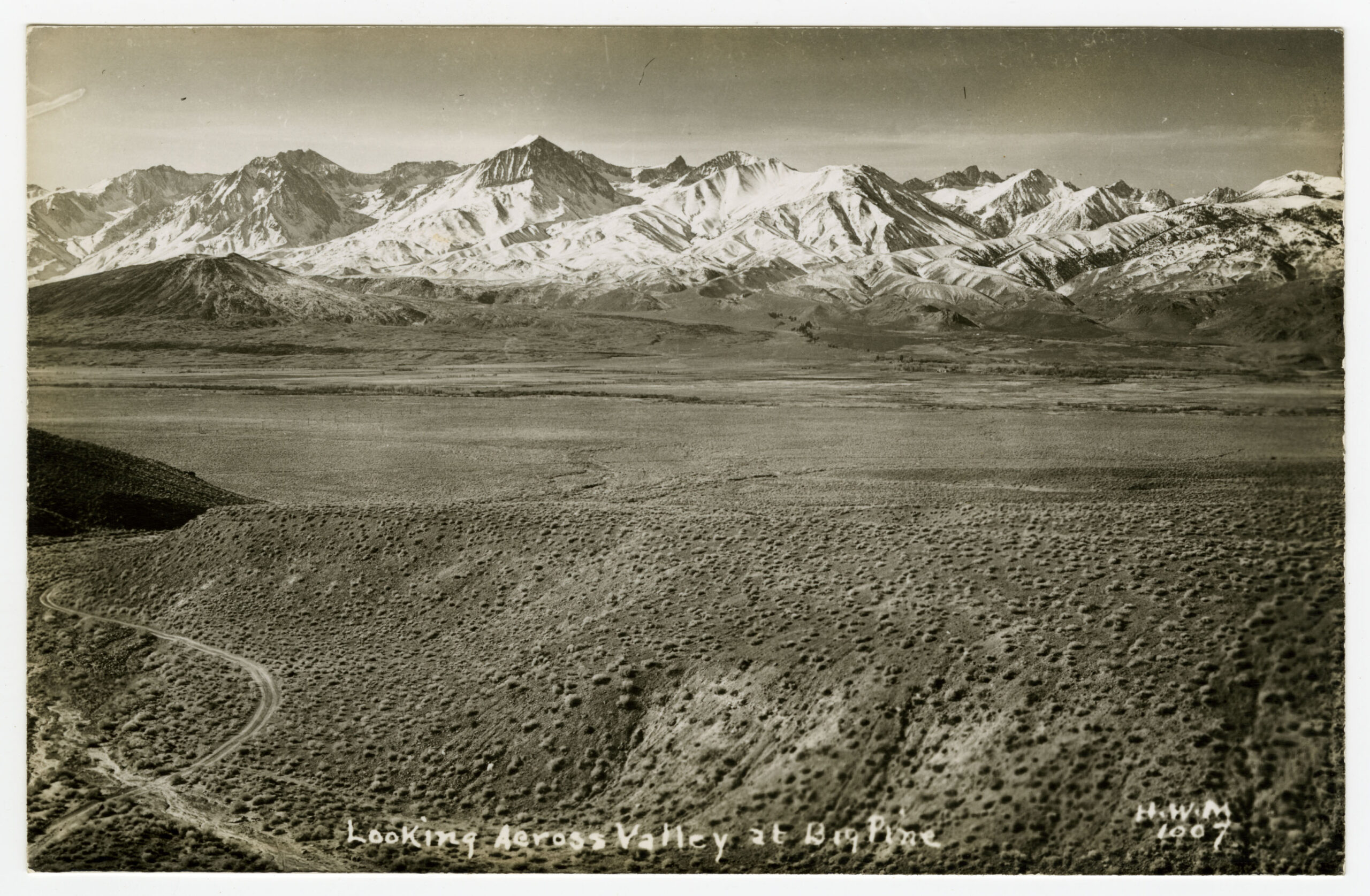
View of the floor of the Owens Valley, looking west to the town of Big Pine and the Sierra Nevada. (Photo by Harry W. Mendenhall, J. D. Black Papers, Department of Archives and Special Collections, William H. Hannon Library, Loyola Marymount University)
For Coleman, there’s a personal element at work. During the 1980s, his great-great-grandmother was recorded by an anthropologist who used her words to create a written grammar of the language. “What’s interesting,” he observes, “is that I didn’t know the grammar existed until I was 25, and when I finally discovered the research, it was locked behind UC San Diego’s academic paywall.” This, of course, is common university practice, but it highlights a divide between the protocols of research — or preservation — for its own sake and the more immersive engagement to which Coleman aspires. Think of the first approach as a lepidopterist fixing a butterfly to a pin in a laboratory and the second as field work. And yet, what Coleman discovered once he began to immerse himself in the discourse around endangered languages was that the discipline itself was in a state of flux. “When I started to work in this area,” he says, “I met with people doing traditional language documentation, or traditional computational linguistics, or documentation of indigenous languages. I learned that a lot has changed in the last 50 years. For linguists and archivists, community-oriented efforts are at the top of everybody’s mind.”
So, how can artificial intelligence be used nonextractively? To address this question, Coleman organized and hosted a three-day workshop at LMU this past June on “AI and Indigenous Language Revitalization.” Funded by a $50,000 National Science Foundation grant, the event brought together not only linguists, computer scientists, and artificial intelligence researchers, but also community members and students. “AI,” Coleman suggests, “is still very much in the extractive phase of its research lifespan. Our goal was to bring together people from all these different backgrounds and discuss what responsible AI looks like, and hopefully to learn from the decades of progress on the language documentation side how to go from a largely extractive process to a more community-driven one.”
Such conversations, Coleman concedes, can be tricky for a variety of reasons, not least the lack of a shared vocabulary. “When you have linguists and computer science people and people from indigenous communities coming together,” he says, “a lot of times, they’re talking over each other.” Even more — and especially in regard to indigenous participants — there is a long, and well-earned, legacy of distrust. “There’s the history of extractive research,” Coleman points out. “That’s one thing that makes it difficult. And then the other big thing, the most difficult one, I think, is that indigenous communities are not a monolith. They’re very heterogeneous in their needs, in the status of their languages, in their cultures. So, trying to come up with some prescriptive guidance of how to do AI is a futile effort. There’s no possibility of working with one-size-fits-all recommendations.”
That sort of flexibility is a key aspect of the AI ethics Coleman is chasing: a way to approach both indigenous language preservation and artificial intelligence that is, by turns, expansive and community-based. I think of the model he’s applied to the language of the Big Pine Paiute, a hybrid called Large Language Model-Assisted Rule-Based Machine Translation (LLM-RBMT). The mechanics, I’ll admit, are a bit beyond me, but the basic idea is to use strict grammatical and vocabulary guidelines as linguistic guardrails. This is critical in regard to endangered languages because they lack a critical mass of speakers to mitigate machine-generated miscues. “If I train a translator that produces incorrect translations in Spanish,” Coleman posits, “it’s not going to ruin the Spanish language. We have millions of speakers who will correct them. But that’s not true for indigenous languages. If I create a translation tool for my community that produces incorrect translations, it’s very easy for that misinformation to spread in learner communities.”
The tendency to spread misinformation is — as we have all come to recognize — a prevailing issue with the technology. It’s not just the slop glutting the information market, but something more foundational. “Where AI promises magic,” Ross Perlin, co-director of the Endangered Language Alliance, wrote in 2024, “the most pressing need is for basic research, driven by communities. In-depth language documentation is difficult and costly, entailing years of work finding, getting to know and recording a range of speakers who can showcase as naturally as possible all the things a language can do.” In his 2024 book, “Language City,” Perlin describes an encounter with the last native speaker of Lenape. “Now there’s nowhere to hear the language outside the walls of my head,” she laments. With only a handful of fluent speakers, the Big Pine Paiute language faces a similar crucible. For this reason, Coleman’s Kubishi Research Group (the name is derived from the Big Pine Paiute word for “brain”) offers not only a dictionary and translation tool but also community learning resources. “The language program,” he notes, “is involved in both preservation and revitalization. Preservation means maintaining the archive and other materials, to make sure we have everything written down so the language doesn’t disappear. On the revitalization side, classes are offered on the reservation. There’s also a program that teaches children at the Head Start program.”
And yet, as Coleman readily admits, there is a gap between these two initiatives. “The program,” he says, “has done amazing work preserving the language, but the revitalization part is very difficult. To put it simply, we haven’t succeeded yet in creating a new generation of speakers. And that’s the goal, right? Eventually, that’s where we want to get to, because we’re running out of speakers. In my family, my great-grandfather was the last one to speak the language, and he didn’t teach my grandmother. She said he would only speak it when he drank.”
What Coleman is describing is not uncommon. My grandparents, Jewish immigrants from Eastern Europe, spoke Yiddish but never taught it to their children. At the same time, there’s no denying that this creates a gap. The question, as with so much else, is what we do to make repair. Language, after all, has many functions, but perhaps most essentially it represents a way of seeing, a way to perceive or position oneself within the world. “So much history,” Coleman observes, “is encoded in language.” As an example, he cites “the number of words we have for pine nuts because they’re such an important part of our culture. We also have tons of words about irrigation and agriculture.” Not only that, he adds, but “our place names are often based on events that happened in the stories. Like, that’s where Coyote did this, or Frog did this.” If the language doesn’t survive, the history is lost.
As for how to encourage more speakers, Coleman takes an ecumenical approach. “Some tribes,” he acknowledges, “are a lot more restrictive about who they’re willing to teach their languages, but we are very open to teaching anyone.” This is not to say the entire culture is made accessible to outsiders; that would be another form of extraction. Certain rituals and narratives are considered sacred and reserved for tribal members. But the most important challenge is to help learners — of whatever background — immerse. When Coleman was a college freshman, his roommate was one of a number of Brazilian students in the U.S. on an exchange program; because he was surrounded by Portuguese speakers, he became “pretty much fluent in six months.” With the Big Pine Paiute language, there is no equivalent opportunity. “This is another difficulty,” he says, “with revitalization. How does the language program create that kind of environment when we have so few speakers?” Here, too, he thinks technology can help. “It won’t be the solution by itself,” Coleman clarifies, “but it can help put the language in more places so people can experience it outside of just the one hour of class.” Think of this as Duolingo for indigenous speakers, albeit with more urgency. “What does revitalization mean?” Coleman asks. “It means to make it vital to learn the language. To do that, you need environments where using the language is necessary. If English is always a fallback, you’re not revitalizing. You have to locate the language where the people are.”
This intention — of locating the language — brings us back to the AI model Coleman has developed, which, in turn, re-centers the matter of ethics once more. “What does ethical AI look like?” he muses. “It depends on the context.” With LLM-RBMT, this means keeping the large language model constrained. In part, that’s the role of the grammatical guardrails, but it also has to do with sample size. A small language model, in other words, which is to say: one that doesn’t require the power of a data center. There are environmental advantages, which seems fitting, given the Big Pine Paiute’s deep connection to place. Equally important is increased accessibility. “Small language models,” Coleman argues, “have benefit along two different axes. They’re smaller, so they consume less energy. And because they’re smaller, they can also run on local hardware, like indigenous-owned servers or computers. So, from a data sovereignty perspective, that’s an advantage, as well.”
Nonextractive, again, which is the necessary ethos. A multilayered method that makes room for a shifting landscape of complexities. Call it a paradigm, a framework for considering culture as a living entity, with language as its animating force. “Human history and culture are all encoded in language,” Coleman asserts. “So, when you lose a language, you’re losing an entire world.” The stakes, it should go without saying, could not be higher. The same is true of the rewards.
David L. Ulin is the author or editor of more than 20 books, including the novel “Thirteen Question Method and Sidewalking: Coming to Terms with Los Angeles,” shortlisted for the PEN/Diamonstein-Spielvogel Award for the Art of the Essay. The recipient of fellowships from the Guggenheim Foundation, the Lannan Foundation, and Ucross Foundation, as well as a COLA Individual Master Artist Grant from the City of Los Angeles, he is a professor of English at the University of Southern California, where he edits the journal Air/Light. His “Climate Chaos” appeared in the winter 2022 issue (Vol. 10, No. 2) of LMU Magazine.