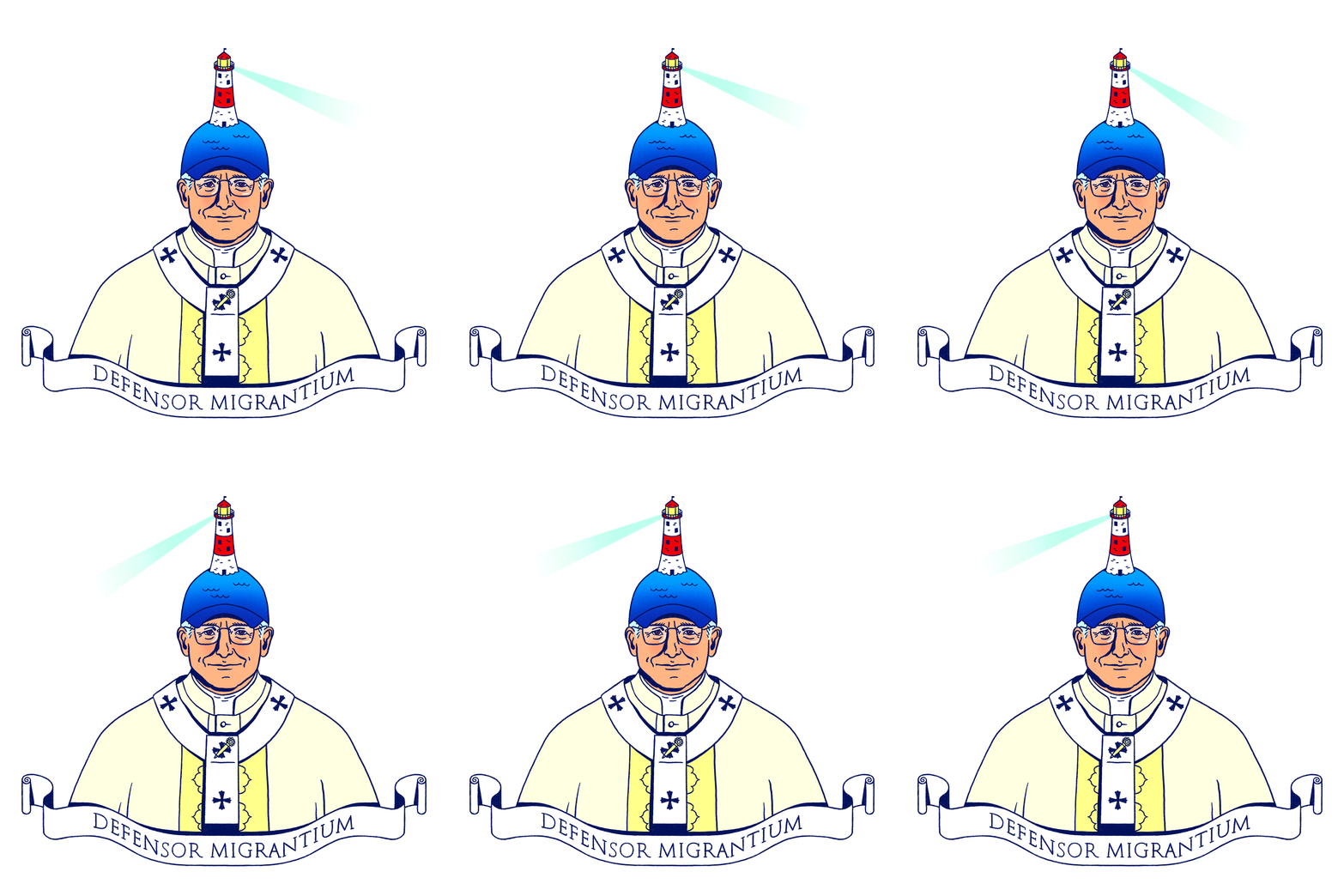
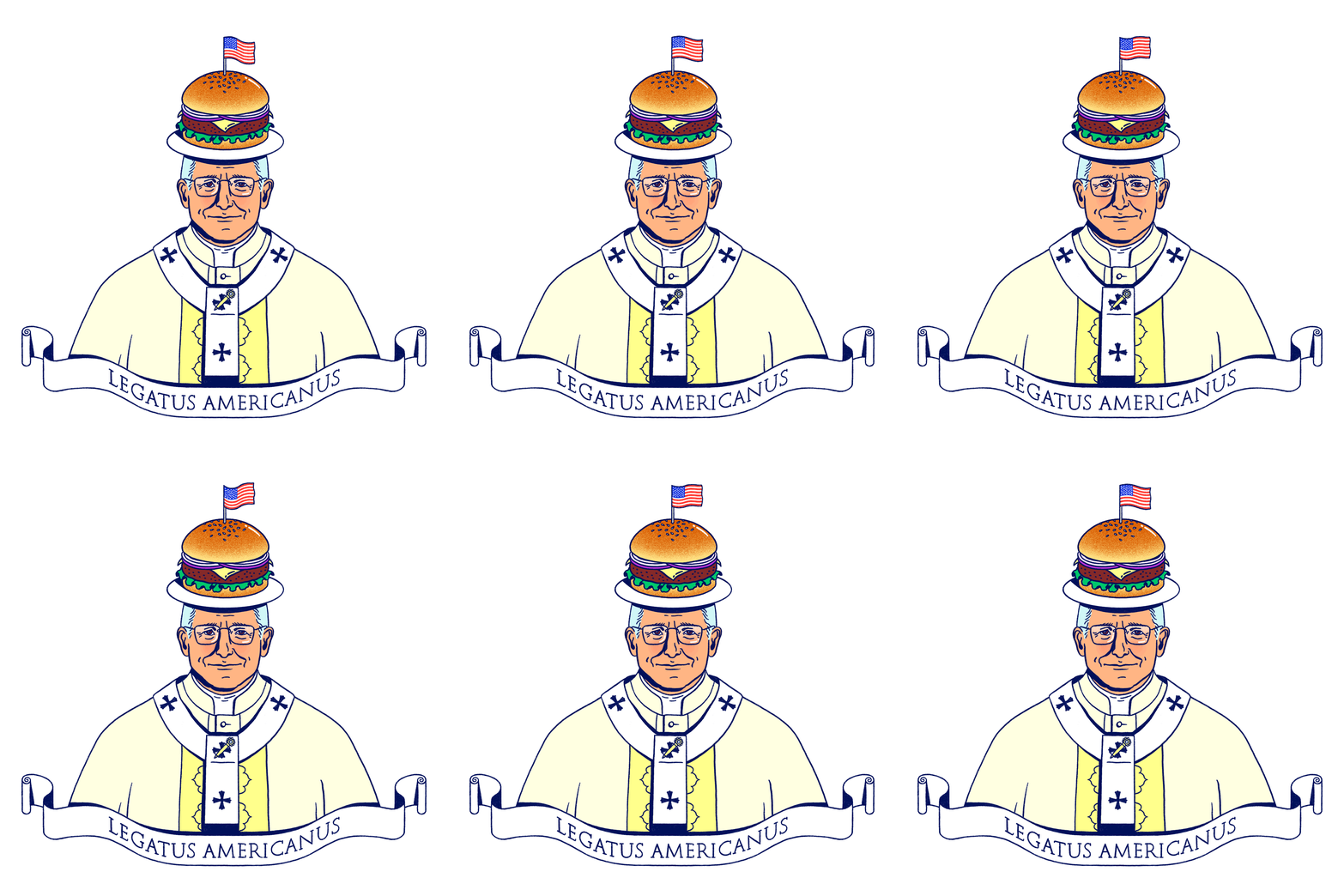
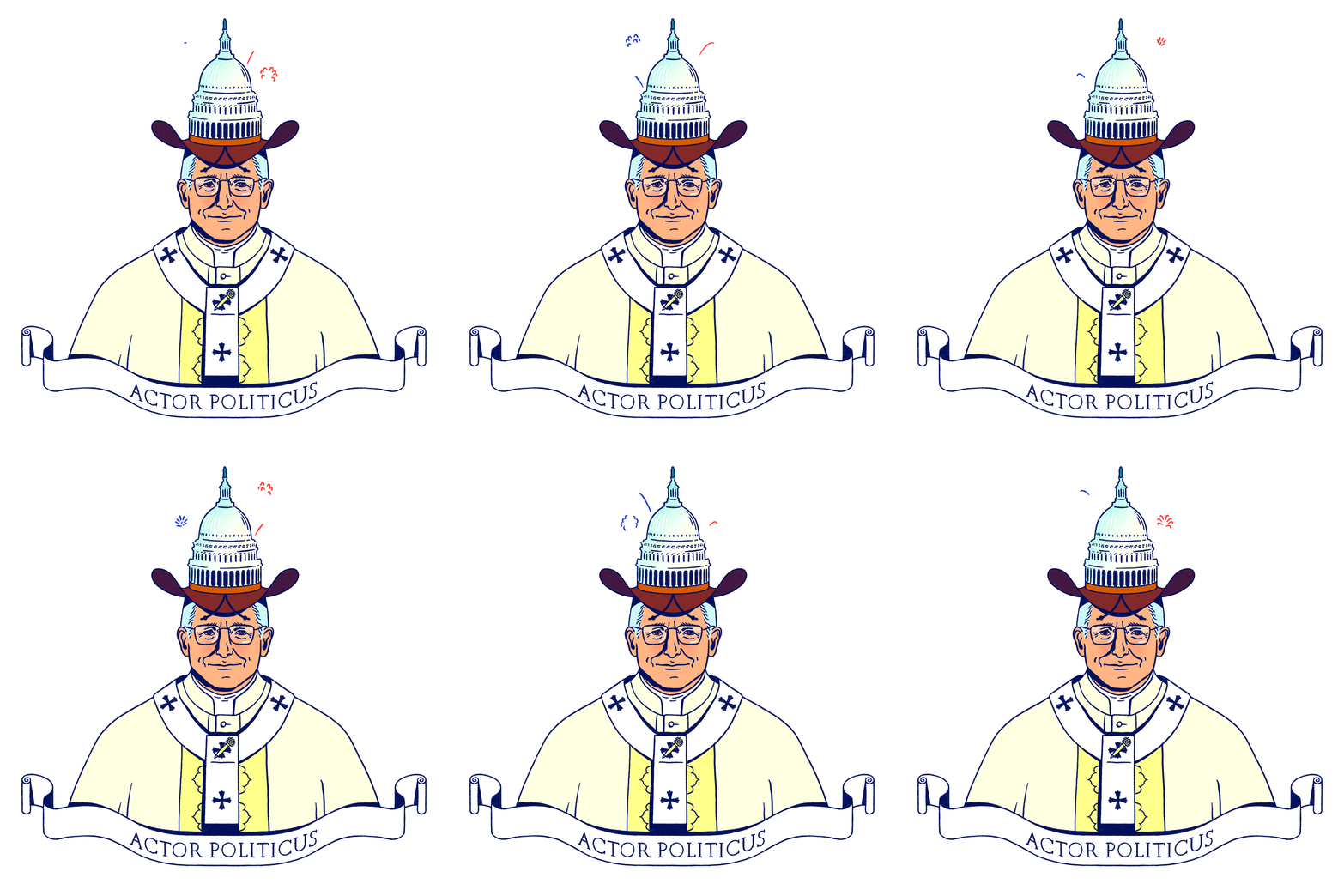
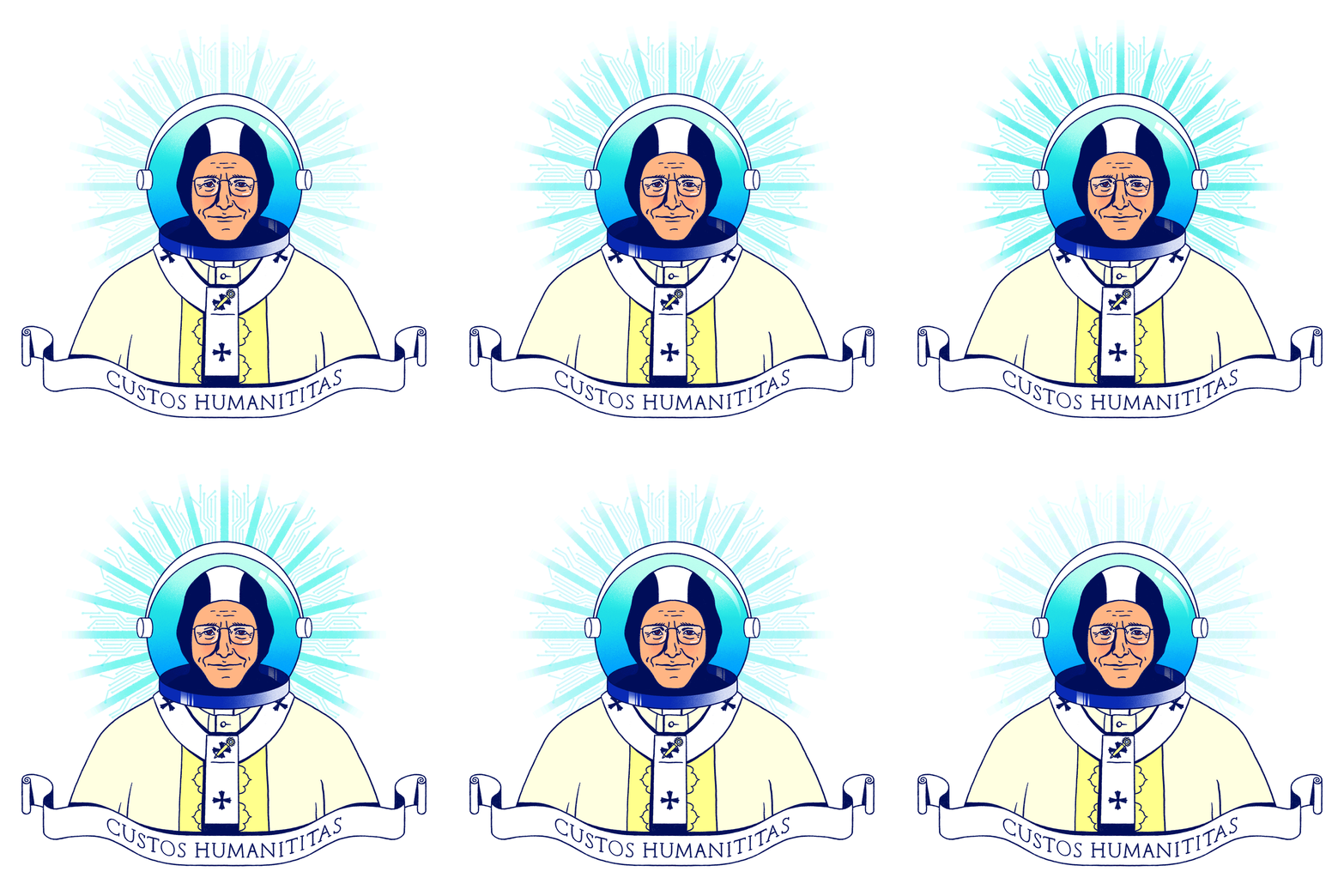
In 18 months, the man formerly known as Robert Prevost has already carved out a legacy as Pope Leo XIV marked by Midwestern humility, a courage to address world issues, and a distinct American ordinariness. Leo does the New York Times’s daily Wordle puzzle, emails with his MAGA-supporting brother, and cheers on the White Sox. (It’s probably a coincidence, but Leo’s beloved baseball nine are currently enjoying their best season in memory.)
But the canon lawyer who spent decades as a missionary in Peru during a violent political period is also a serious and careful thinker keen on honoring the majesty of his vocation. In his first homily, on May 18, 2025, the newly crowned Pope Leo XIV said: “I was chosen, without any merit of my own, and now, with fear and trembling … .” He then laid out seeds of deep meaning and reflection about headline human issues, especially migration, artificial intelligence, and the rise of far-right politicians. “If the rock is Christ, Peter must shepherd the flock without ever yielding to the temptation to be an autocrat, lording it over those entrusted to him,” he said. “On the contrary, he is called to serve the faith of his brothers and sisters, and to walk alongside them, for all of us are ‘living stones.’”
LMU theologians and other experts have watched Leo’s emerging papacy closely: from his pastoral care, thoughtfulness, and willingness to take on thorny issues to his understanding of modern media and his Americanness — even his youthfulness in pope years. Yet, they suggest it is too early to tell what difference his papacy will make in the life of the church.

Comparisons with Francis
Inevitably, Leo’s identity has been contrasted with that of Pope Francis, the extroverted, gregarious Jesuit who passed Leo the torch after his death on Easter Monday of last year. Francis frequently rocked the church with improvised speeches that sometimes seemed to flip church thinking.
Leo is a more deliberate leader, not given to loose-lipped soliloquies. “Every pope is compared with the predecessor,” says Dorian Llywelyn, S.J., director of the LMU Center for Ignatian Spirituality. “One of the things to think about is the difference in style. The style is the content in many ways. Pope Francis was a Roman outsider, while Leo is a more deft operator. There was a certain unpredictability with Francis, which became a predictable unpredictability.”
“There’s more of a systematic focus than Francis,” says Roy Fisher, who teaches theology in the LMU Bellarmine College of Liberal Arts. “He’s deeply vested in the interests of the church, but not in a backward-looking way. He speaks to the real needs of individual humans.”
One thing the two popes have in common is their ability to appeal to non-Catholics. “I’ve been excited from afar just because I feel like he’s spoken to so many of the things that are important for me,” such as immigration, tolerance and discrimination, says Michelle Amor Gillie, a Protestant and a native Chicagoan who teaches screenwriting in the LMU School of Film and Television. “I just feel like we need people who aren’t afraid to speak about the issues that face the world. He understands that faith cannot be separated from what is happening in the world. I think that a lot of times when people are in their space, they like to be in this bubble. Also, he’s from Chicago.”
Core to Pope Leo’s identity is his membership in the order of the Augustinians, which he joined in 1977. For 12 years, he even served as prior general in the order, which says it “values truth, unity, and compassion for all of God’s creation.” It’s another contrast to Francis. “Jesuits are very good at telling you what they’re all about,” notes Llywelyn, a Jesuit. “Augustinians don’t do that. Whenever I heard Francis talk, I could hear the Jesuit novice master. With the Augustinians, whatever it is, it has a lower key. … you don’t always feel that with Leo.”

The American Pope
Because Pope Leo is from the U.S., there was immediate curiosity about how vocal he would be about the Trump administration, and its often barbaric treatment of immigrants.
Leo is “American-born and he’s an English speaker, and he understands the context of the United States in ways that we’ve had no modern pope be able to understand, and the inside workings of the United States and how politics works here,” says Cecilia González-Andrieu ’80, M.A. ’01, who teaches theology. “He’s able to talk directly to the White House. ‘In your face. What you’re doing is completely sinful.’” It also helps, she adds, that he’s only 71. “He’s young in pope years, so he can handle all the social media,” she says.
In March 2026, Leo, while not naming the U.S. or Israel, called for a ceasefire in the Iran war. A month later, he condemned President Donald J. Trump’s threat to annihilate Iranian civilization. That drew the attention of the American president, who called the new Bishop of Rome “weak on crime” and “terrible on foreign policy.” He added in a press conference: “I’m not a fan of Pope Leo.”
Trump later piled on, writing that Leo was only elected pope “because he was an American, and they thought that would be the best way to deal with President Donald J. Trump. If I wasn’t in the White House, Leo wouldn’t be in the Vatican. Leo should get his act together as Pope, use Common Sense, stop catering to the Radical Left, and focus on being a Great Pope, not a Politician. It’s hurting him very badly and, more importantly, it’s hurting the Catholic Church!”
Leo responded that he had “no fear of the Trump administration.” “I do not look at my role as being political, a politician,” he explained. “Too many people are suffering in the world today, too many innocent people are being killed, and someone has to stand up and say there’s a better way.”
Leo, says Llywelyn, “doesn’t lead with his Americanness, but his Americanness is there.” He can speak with an authority, as an American, to President Trump. It’s an interesting outrage, because it is firm, but it’s not personal. He certainly speaks as an American, but he offers a different vision of what humanity is about.”
When Robert Prevost arrived in Peru in 1985, the country was in the midst of a civil war waged between the government and the Shining Path, a far-left revolutionary group. “I think that has shaped his attitude toward politics,” says Brett Hoover, who teaches pastoral and practical theology. “He’s a bit more suspicious. Like ‘God bless and keep the Tsar … far away from us,’ and he only kind of speaks up when he feels like he has no choice, and a basic Christian value is under attack. That’s why his implied critiques of Donald Trump and to some extent J.D. Vance are not always specific.”
For many Americans, it’s been a new experience to have a pope who’s a native English-speaker. With Francis, “I could get to the native language of a pope for the first time,” says González-Andrieu, who grew up speaking Spanish in her home. “With Leo now, we all have it. We have that inside track. We can hear and feel his original thought, his original words.” When Leo was first elected, he spoke in Spanish and Italian. “That meant a lot to the immigrant community of the United States,” she adds.

Leo has made the Second Vatican Council a “clear guidepost for his papacy,” says Brown ’08.
The Carrot and the Stick
Fisher and others point out that Leo has engaged with more conservative parts of the church, including celebrants of the traditional Latin Mass, including conservative U.S. Cardinal Raymond Burke. “He let Raymond Burke celebrate Latin mass in St. Peter’s Basilica,” says Fisher. “At the same time, he has no problem using the authority of St. Peter’s chair to say you’re out of bounds.”
In July, Leo ordered the Vatican to declare a schism and excommunicate six bishops from the extremely conservative and traditionalist Society of St. Pius X, after it conducted rogue appointments of bishops.
In doing so, Leo “enforced a pretty clear rule, and it’s a rule that John Paul II enforced in the same manner in 1988 as well,” says Kevin Brown ’08, who teaches theology at Gonzaga University. “Consecrating a bishop outside the communion of the church would entail the participation of validly ordained, illicitly ordained bishops.” A schismatic act is defined by canon law. “Something can be schismatic without it being formally declared.”
At the same time, Leo has made the Second Vatican Council a “clear guidepost for his papacy,” says Brown. That means he’s open to dialogue but only with church leaders who accept the Council’s changes. “Leo went to a seminary that had fully integrated Vatican II into its theology, so it’s been a way of engaging the world theologically since his early teens,” says Brown. “It’s pastoral to say we’re open to reconciliation, and open to a position in the life of the church. And [the Pius X traditionalist bishops’] position was you’re continuing on the path of Vatican II, so it’s hopeless [to dialogue].”
As a mixed-race descendant of immigrants (his maternal grandfather was born in Haiti) and a longtime immigrant himself in Peru, Pope Leo can speak with unique authority on immigration issues.
The new encyclical, in addition to its focus on artificial intelligence, is in continuity with “Fratelli Tutti,” Francis’ encyclical that emphasized the shared humanity of all nations, says Fisher. “He puts migration on the same level as abortion, the death penalty. It’s about the sanctity of life.”
Pope Leo, says González-Andrieu, “brings an understanding of the people who go into forced migration. He’s someone who’s schooled in all these documents from the bishops of Latin America talking about systems and structures. Systems that are broken economically and environmentally. We’ve built up systems that are inhuman and inhumane, and those have to be questioned.”
González-Andrieu adds that Leo is trying to appoint bishops who are “shepherds of the community’s needs” and “walk with them and smell like them, like Francis said, to look for them, to find them, to bring them into effective leadership in the hierarchy of the church” and “to get rid of careerism and a mindset of a clericalism that that helps no one except people who want to make careers, and which was also central to what Pope Francis was trying to do. Now Leo wants to help us as a global church to truly be global. This goes into migration. Because if we are the Catholic Church, that means everybody.”

Trying to get the Vatican to talk to Silicon Valley “is like trying to get your fridge to talk to your washing machine,” says Llywelyn.
In choosing his papal name, Leo indicated he was prepared to tackle the world’s most important social, political, and economic issues. Leo XIII is the pope who wrote “Rerum Novarum,” the 1891 encyclical that tackled the most important labor issues of the 19th century’s industrial revolution. The corresponding issue of the day is technology and especially artificial intelligence. That’s what Leo tackled in his encyclical “Magnifica Humanitas” (“Wonderful Humanity”), subtitled “On safeguarding the human person in the time of artificial intelligence,” published in May.
The 42,000-word encyclical lays out a vision of the human person as possessing a dignity that technology cannot match. “So-called artificial intelligences,” he wrote, “do not undergo experiences, do not possess a body, do not feel joy or pain, do not mature through relationships and do not know from within what love, work, friendship or responsibility mean.”
The document also called for better treatment of women, and named the “treatment of migrants, refugees and those forced to move due to poverty, violence, climate change and environmental disasters” as an essential moral litmus test.
But will the encyclical make a difference? “It’ll be hard to catch the attention of the movers and shakers of the tech sector. It’s a very profit-driven environment, so trying to get people to pause” is difficult, says Llywelyn. Trying to get the Vatican to talk to Silicon Valley “is like trying to get your fridge to talk to your washing machine.” Also, the technology is changing so fast that it’s too early to tell. “Maybe in two years’ time,” he adds, “if Pope Leo’s still with us, there’ll be another encyclical on this.”
John W. Miller is a Pittsburgh-based former Wall Street Journal staff reporter and co-director of the PBS film “Moundsville.” He has also written for America magazine, Jesuit Media Lab, Time, and NPR. Miller is the author of “The Last Manager: How Earl Weaver Tricked, Tormented, and Reinvented Baseball,” a New York Times bestseller.