October 11, 2016

Concussions

Share this story
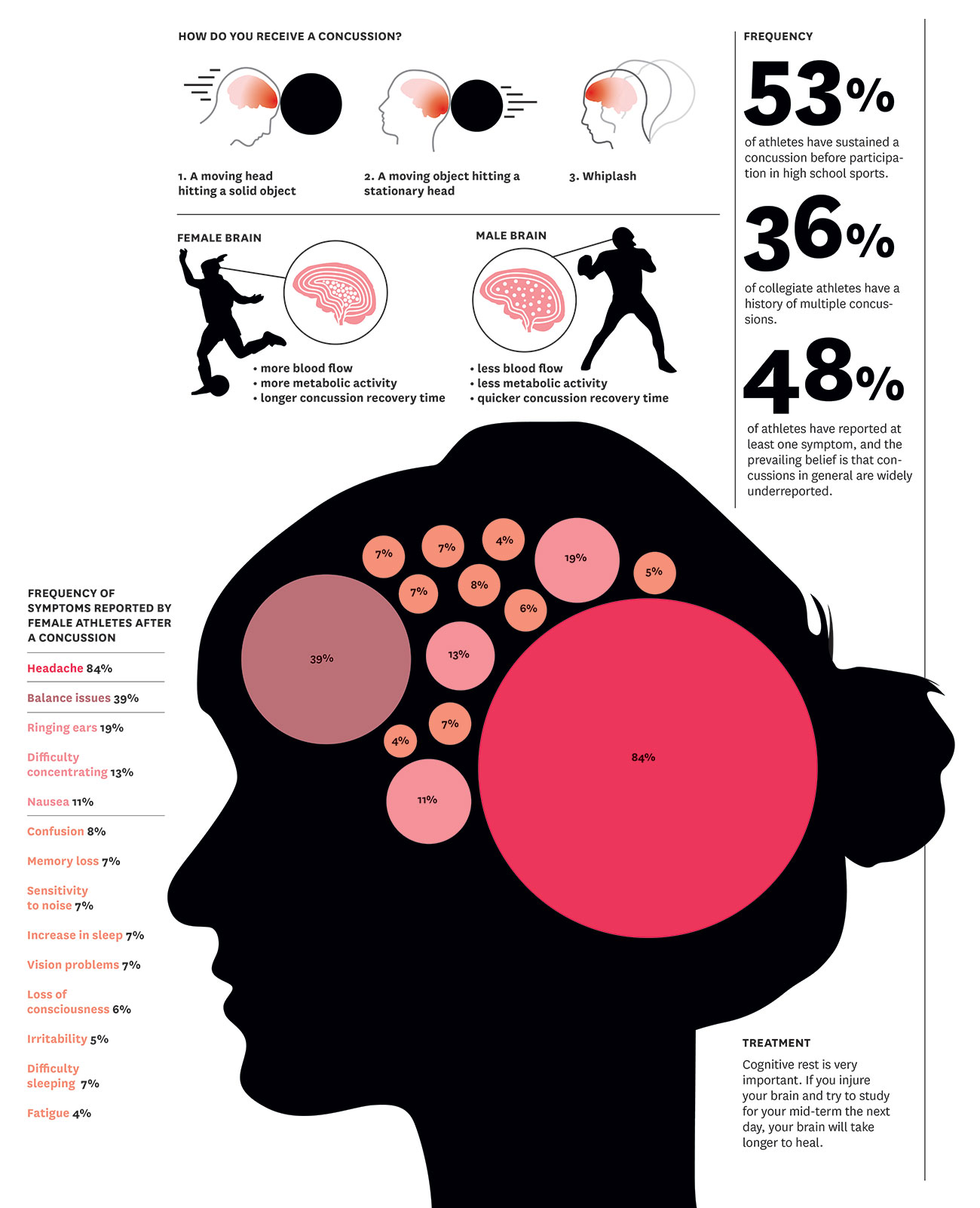
An infographic about brain concussions.

HOW DO YOU RECEIVE A CONCUSSION?

  • A moving head hitting a solid object
  • A moving object hitting a stationary head
  • Whiplash

FEMALE BRAIN

  • more blood flow
  • more metabolic activity
  • longer concussion recovery time

MALE BRAIN

  • less blood flow
  • less metabolic activity
  • quicker concussion recovery time

FREQUENCY

  • 53% of athletes have sustained a concussion before participation in high school sports.
  • 36% of collegiate athletes have a history of multiple concussions.
  • 48% of athletes have reported at least one symptom, and the prevailing belief is that concussions in general are widely underreported.

FREQUENCY OF SYMPTOMS REPORTED BY FEMALE ATHLETES AFTER A CONCUSSION

  • Headache — 84%
  • Balance issues — 39%
  • Ringing ears — 19%
  • Difficulty concentrating — 13%
  • Nausea — 11%
  • Confusion — 8%
  • Memory loss — 7%
  • Sensitivity to noise — 7%
  • Increase in sleep — 7%
  • Vision problems — 7%
  • Loss of consciousness — 6%
  • Irritability — 5%
  • Difficulty sleeping — 7%
  • Fatigue — 4%

The circles inside the head repeat those symptom percentages visually:

  • 84%
  • 39%
  • 19%
  • 13%
  • 11%
  • 8%
  • 7%
  • 7%
  • 7%
  • 7%
  • 7%
  • 6%
  • 5%
  • 4%

TREATMENT

Cognitive rest is very important. If you injure your brain and try to study for your mid-term the next day, your brain will take longer to heal.