
Manny Romero ’97

Manny Romero ’97 works as the Sacramento Kings’ head athletic trainer where he uses cutting-edge monitoring technology to prevent injuries and improve injury recovery times.
Manny Romero ’97 probably knows more about the Sacramento Kings players than their agents.
As the NBA team’s head athletic trainer, he runs the team through an array of biomedical information gathering using cutting-edge monitoring technology to prevent injuries and improve injury recovery times.
Romero spends about 70 percent of his week working with the athletes. Romero also has a seat on the Sacramento bench during games. He studies the players’ movements, closely watching those recovering from injuries and looking for abnormal movements that may signal small injuries or fatigue. The Kings are perennial leaders in fewest games lost due to injuries. Romero holds a master’s degree in exercise science and a Ph.D. in athletic training. As a biology major at LMU, Romero took courses in biology, biochemistry and physics. That’s where he learned to think critically and solve complex problems, he says. Professors Philippa Drennan and John Waggoner were his mentors. “I wasn’t their strongest student, but they always encouraged me,” he remembers. “When things were hard, they always said, ‘You can do this.’ ”
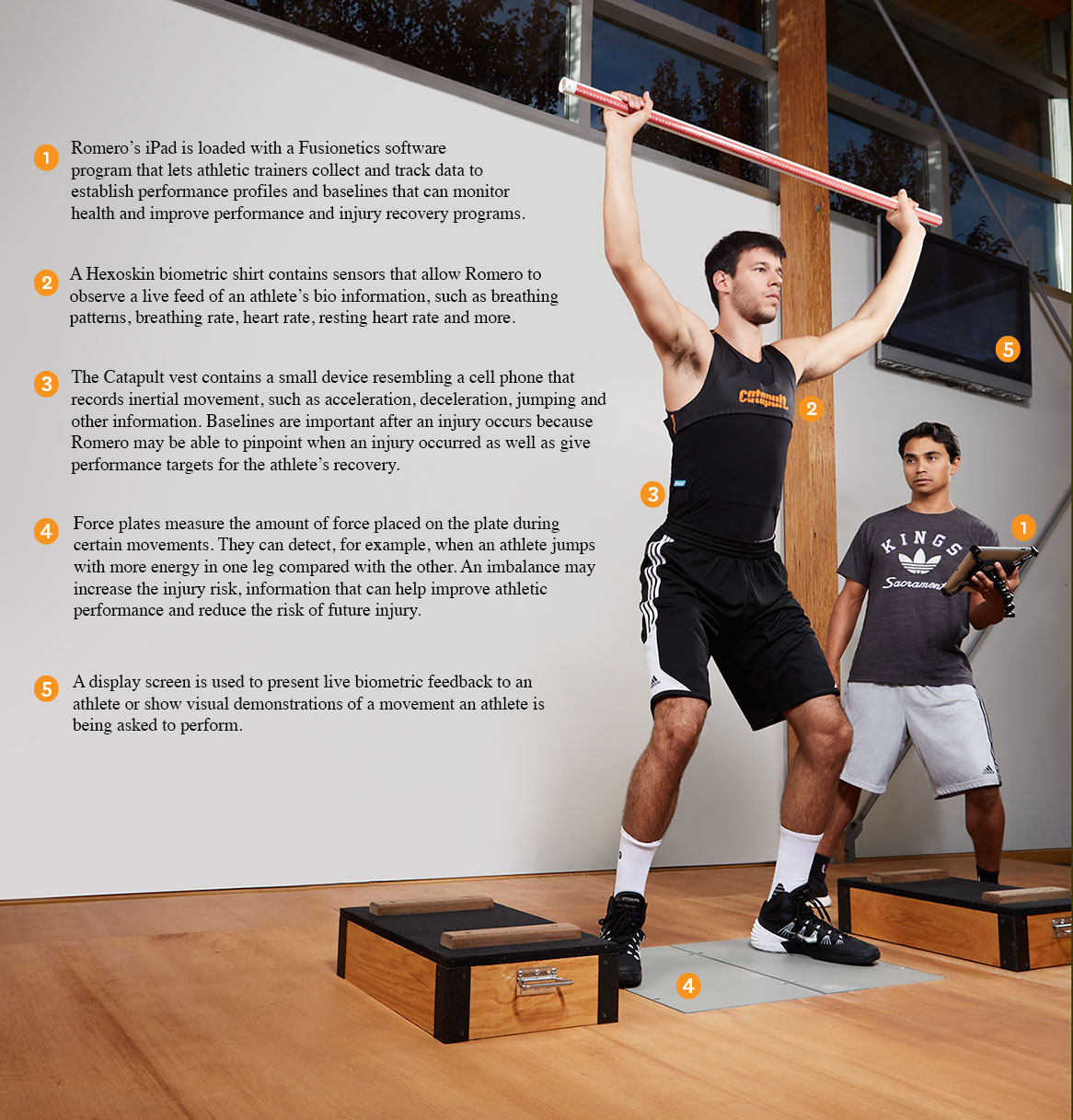
We asked Romero to describe some of the tools he works with to improve the performance of his players.
From the image:
- Romero’s iPad is loaded with a Fusionetics software program that lets athletic trainers collect and track data to establish performance profiles and baselines that can monitor health and improve performance and injury recovery programs.
- A Hexoskin biometric shirt contains sensors that allow Romero to observe a live feed of an athlete’s bio information, such as breathing patterns, breathing rate, heart rate, resting heart rate and more.
- The Catapult vest contains a small device resembling a cell phone that records inertial movement, such as acceleration, deceleration, jumping and other information. Baselines are important after an injury occurs because Romero may be able to pinpoint when an injury occurred as well as give performance targets for the athlete’s recovery.
- Force plates measure the amount of force placed on the plate during certain movements. They can detect, for example, when an athlete jumps with more energy in one leg compared with the other. An imbalance may increase the injury risk, information that can help improve athletic performance and reduce the risk of future injury.
- A display screen is used to present live biometric feedback to an athlete or show visual demonstrations of a movement an athlete is being asked to perform.