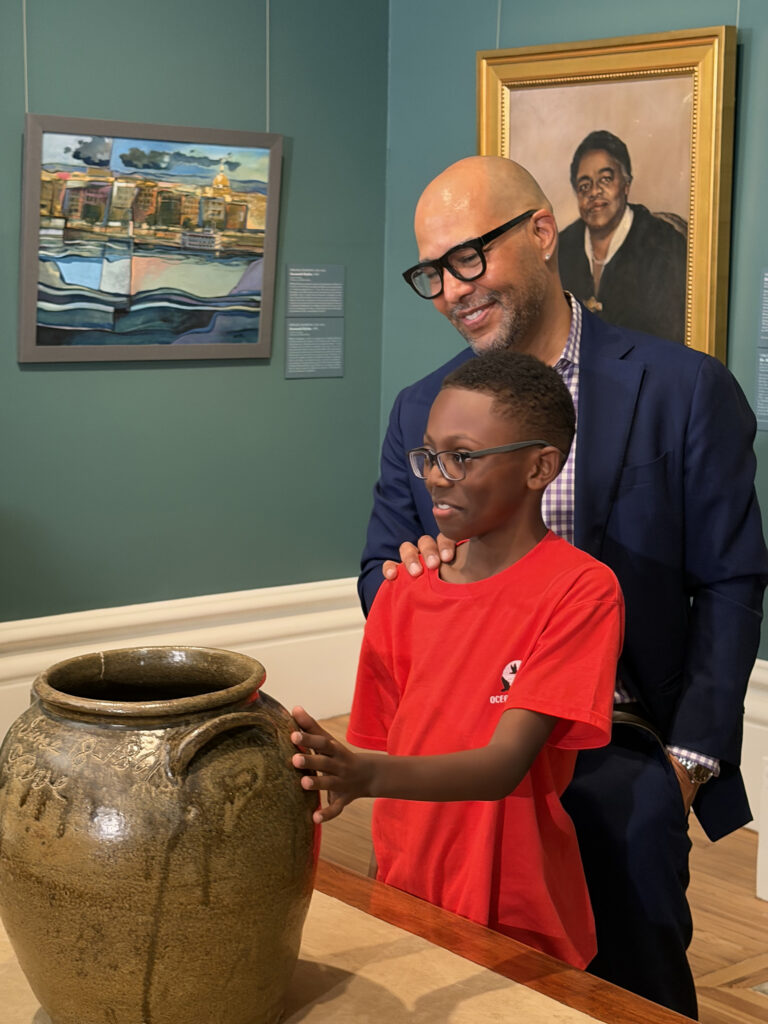
Gazing at the 14-inch, alkaline-glazed jar that welcomes visitors to the Telfair Museums in Savannah, Georgia, the 8-year-old boy turned to George Fatheree III in June and asked the once unthinkable: “Can I touch it?”
“I looked him in the eye and said, ‘Lennox, you don’t have to ask anyone’s permission to touch this. The jar belongs to you,’” says Fatheree, urging the boy to feel the vessel created by his enslaved great-grandfather, David Drake, in 1861, the same year the Civil War erupted. Fatheree encouraged the boy to put his hand inside the jar, glazed and fired in South Carolina for food storage. There, he found a light indentation — the loops and whorls of Drake’s fingerprint. “That’s your grandfather, that’s your ancestor,” Fatheree told him at the time. “It was a powerful moment,” Fatheree says as he looks back now.
The road to that moment — and the larger effort to ensure ethical ownership of a handful of the artist’s thousands of creations — started unexpectedly back in 2022. Fatheree, a Los Angeles-based attorney, had just helped secure $20 million in reparations for descendants of a Black family who owned Bruce’s Beach, a waterfront resort for African Americans that was improperly seized by the city of Manhattan Beach in 1924.
Fatheree began to receive daily phone calls and emails from families around the country seeking redress for lost or stolen land. In most cases, there was no legal recourse.
Then came a different kind of call, this one from a Drake descendant inquiring about ethical ownership of jars created by the artist, who was born in 1801 and is thought to have died in the 1870s. While there are federal laws that prescribe methods for repatriating art looted by Nazis, and for misappropriated Native American artifacts, no such remedies exist for artwork created by enslaved Americans.
“David Drake is the highest selling U.S. ceramicist, dead or alive. You’ve got collectors and auction houses continuing to profit, to the exclusion of his family.”
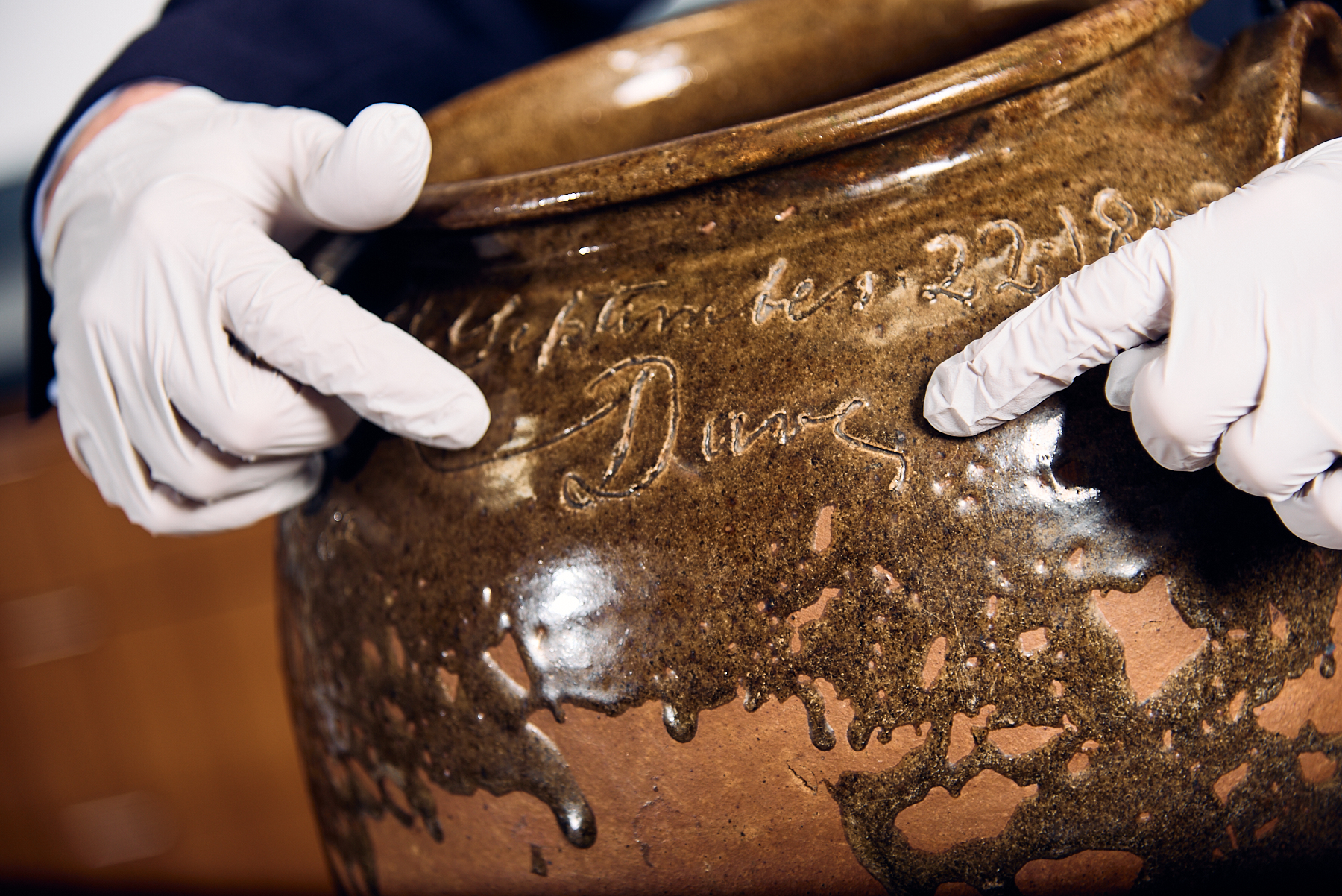
Fatheree had never heard of the artist, known variously by his birth name, “Dave the Potter,” or, simply, “Dave.” Drake, who could read and write, sometimes imprinted his works with poems, many of which can be found in museums and private collections. In most cases, the family never received recompense for their relative’s work.
“I started doing research, and I was fascinated,” says Fatheree, a member of the LMU Board of Trustees and a 2007 alumnus of the LMU Loyola Law School. “David Drake is the highest-selling U.S. ceramicist, dead or alive. You’ve got collectors and auction houses continuing to profit, to the exclusion of his family. I decided to see if there was something I could do to change that.”
Fatheree went on to create a model for ethical restitution, in which owners of coerced cultural property were encouraged to return Drake jars to descendants for moral and historical reasons, rather than legal requirements.
His efforts succeeded when in October 2025, following a year of negotiations, the Museum of Fine Arts in Boston returned a Drake jar to his descendants. The family then sold the creation back to the museum.
Fatheree went on to get five more museums (and three private collectors) to return Drake jars, after which institutions then repurchased the artwork. For museums unable to buy the jars, the family loaned them back to display. The museums included the Milwaukee Art Museum, the Newark Museum of Art, the Georgia Museum of Art, and the Virginia Museum of Fine Arts. Each received a certificate of ethical ownership.
“In our model, the family is not recovering the works and putting them up for auction and selling them to the highest bidder,” Fatheree says. “The family’s not even recovering the work and keeping it in their possession. Instead, they’re extending an invitation back to the museum and creating a pathway for them to own it ethically.”
The process was intentional, he adds, and it gives a museum the opportunity to develop larger lessons for the public on ethical art stewardship. “We celebrate our museum partners,” he adds. “This is collaborative. This is great for their community. It’s a way for the museums to move from beyond ownership and to real stewardship and to demonstrate that they are charitable institutions, and that they exist for the public good.
“There’s room to educate the public around what works are in the museum and how and why they’re there,” Fatheree notes. “How did they get there? Is it really ethical and legitimate ownership, or was a possession acquired through looting, violence, coercion or duress?”
Helping Fatheree was Ryan Maroun ’25, an art history major who helped locate Drake jars. A search for one object could lead to another source, which could lead to another collection, auction record, or reference. When he was done, Maroun had compiled perhaps the most extensive inventory of Drake creations.
He and his wife even visited a Drake vessel on public display in San Francisco. “Seeing it with her, somebody with fresh eyes, really impressed upon me how cool and how special his work was,” Maroun says. “He was a master potter. The cultural value is priceless.”
The work is personal for Fatheree. His surname is that of the Texas slaveholder who owned his great-great grandfather. His efforts aren’t finished.
There is also the part about honoring a question that Drake asked in life and, as well, on one of his jars. Drake, who was sold three times in the course of his life and separated from his wife and children, inscribed on one of his creations: “I wonder where is all my relations?”
Caption goes here.
Fatheree sees the words as a long-range act of agency. Drake left dates and inscriptions on his works that would outlive the conditions imposed upon him. Nearly two centuries later, descendants are using that record to find one another.
“Dave asked this question 180 years ago, and today his family is gathering for him,” he says. “He was the architect. He planned this moment.”
Fatheree hopes next year to bring to 15 the total number of jars that he’s returned to the family. He helped to launch a website, descendantsofdave.org, which is an effort to identify other Drake relatives. Fatheree is driven not just by moral imperative, but also by the memory of a little boy seeing and touching his grandfather’s stoneware for the first time.
“I’ve been working with the family for over three years now,” Fatheree says, “and there was no more powerful moment than when I got the opportunity to explain to Lennox that the jar belonged to him.”
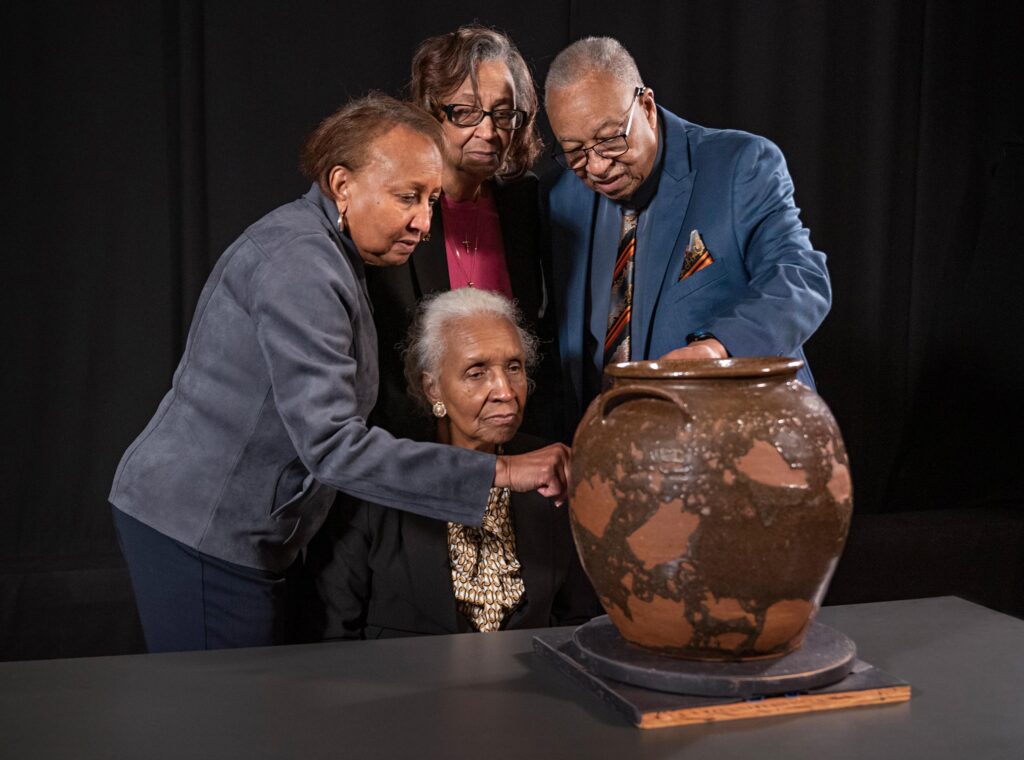
Pauline Baker, Daisy Whitner, John Williams, and Priscilla Williams Carolina, descendants of potter David Drake, at the Museum of Fine Arts, Boston, with one of the artist’s works.
Andrew Faught, a frequent contributor to LMU Magazine, is a Fresno-based journalist who has written for scores of alumni magazines on the issues and ideas of higher education. He has reported for newspapers in Arizona and Southern California. His “The Lines on the Field” appeared in the summer 2025 issue of LMU Magazine.
Photo: Jar, Dave Drake (or Dave the Potter) (American, about 1800–1870)
1857 Stoneware with alkaline glaze. Ethically borrowed from the Dave the Potter Legacy Trust LLC, established for the benefit of the artist’s descendants. Photo © Museum of Fine Arts, Boston.