My father is buried at Holy Cross Cemetery in Culver City, California. Among those also buried there are many of the nuns of the Religious of the Sacred Heart of Mary, including Peg Dolan, R.S.H.M. and Mary Milligan, R.S.H.M. While at Holy Cross with my mother this summer to visit my father’s grave, I looked out southwest at an unexpected sight through the trees. In the distance, across the alluvial plain where the Los Angeles River once flowed, I could see Sacred Heart Chapel atop the Del Rey bluffs. What I couldn’t see that day was another landmark that was long visible to Angelenos on the West Side of the city: the LMU letters.
They’ve been gone since 2024, a startling reminder of the tenacity and authority of nature over humanity’s bold endeavors. The soil on which LMU sits, essentially one bank of the ancient river, is naturally unstable — “Ours is a house built on sand, pace the New Testament example,” former president Thomas P. O’Malley, S.J., once said in a homily — and is prone to erosion in the case of heavy rains. Huge storms across what is usually a parched landscape in 2022–23 caused so much soil to detach from the footings of the letters that the “U” cracked in two places and all three letters faced an inevitable slide into oblivion.
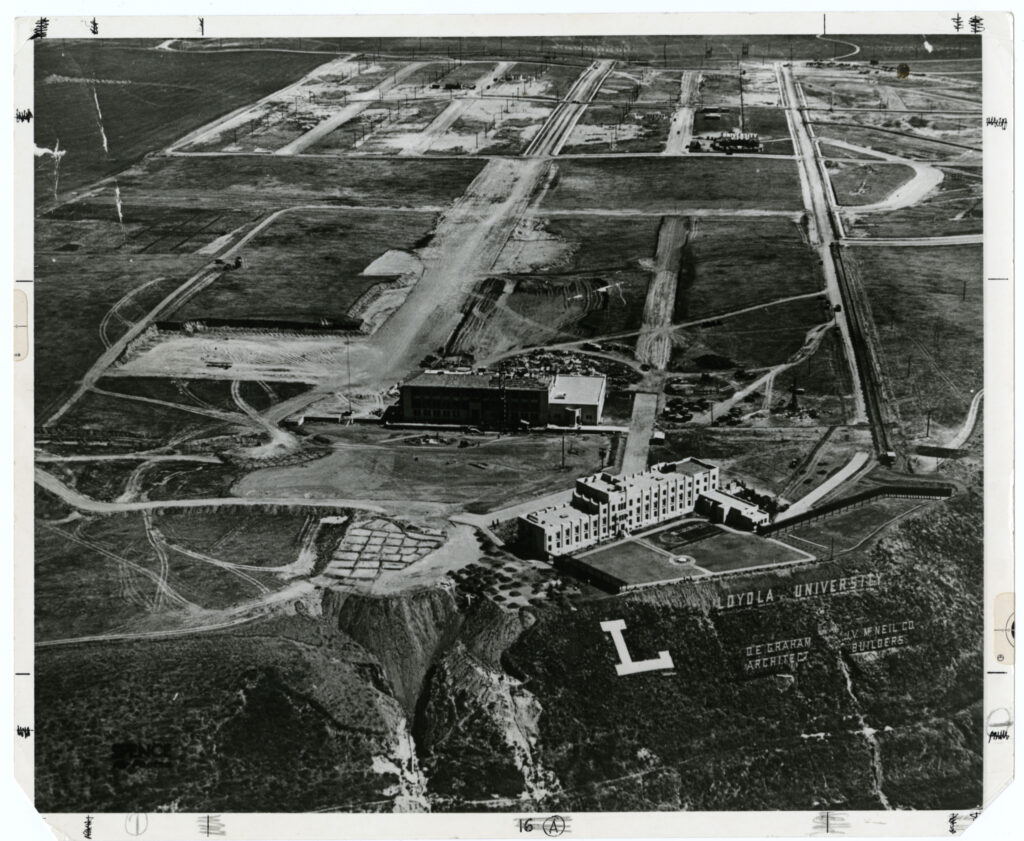
St. Robert’s Hall under construction in 1928, with the Loyola logo “L” on the bluff at the new Loyola University campus. (Department of Archives and Special Collections, William H. Hannon Library, Loyola Marymount University)
LMU had little choice but to cover the letters with reinforced tarps to prevent them from becoming new tenants of Silicon Beach. Soon after, the school decided that they would have to be removed, a process that began in late 2024.
They will be back soon enough, we are told: The “Bluff Mitigation Project” was originally supposed to take five years, but the LMU family can now expect them to be back on the bluff by early 2027.
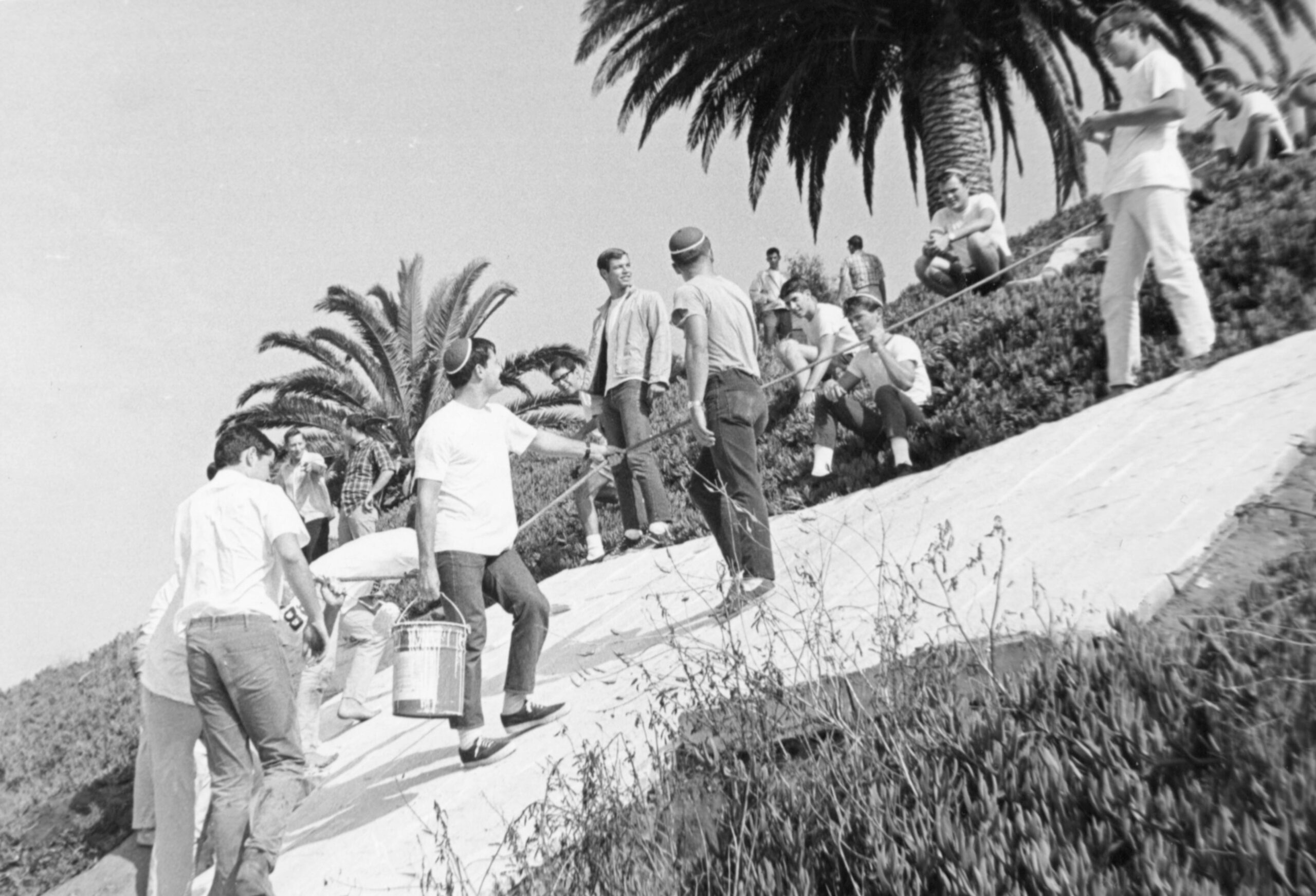
The story of the letters begins in 1928, when the fledgling Loyola College was constructing its first two buildings in the Del Rey Hills, Xavier Hall and St. Robert’s Hall. Soon after, the bluff behind Xavier was adorned with a wooden sign advertising the construction company building the new school as well as a 50-foot brick “L” painted white; both were visible across West Los Angeles. The “L” remained largely unchanged for decades, though it periodically needed weeding to remove growth between the bricks and repainting, a task once performed by first-year LMU students as part of orientation but eventually taken on by the men of Crimson Circle.
In 1970, in the midst of the tumultuous merger between Loyola University and Marymount College and many an argument about the name of the school (one motto of the Marymount students as well as the R.S.H.M. sisters at the time was “no Marymount, no merger”), the judicious use of paint by unknown students caused the still-solo “L” to mysteriously become an “M” for a brief time — an incident described in that year’s yearbook as “Intimations of Maryola.” (I feel like Sister Peg, who arrived at LMU in 1973, would have smiled at that.)
Not until 1975 — two years after the merger of the two institutions was completed — did the university add a permanent concrete “M” and “U” to the venerable “L.” Over two weeks and at the cost of $6,000, the sign took on the appearance it would keep for half a century. There had been some stalling about adding the new letters over the previous two years, Renée Harrangue, R.S.H.M., then the university provost, told the Los Angeles Loyolan at the time. But she felt the completed sign was “the frosting on the cake” of an often-fraught merger process. Loyola Marymount University’s men, said Sister Harrangue, were “finally willing to realize women are here to stay.”
Erin Hennessey, director of the Women’s Center at the newly named university, was skeptical that the change was much more than cosmetic. “Putting letters on a hill will do little to change attitudes on this campus, though it may clear up some confusion about the name among the general public,” she told the Loyolan. “Time will temper the traditions and create new ones, and I hope eventually that the merged institution will be taken for granted.”
In 1978, the letters faced their first serious crisis, when storms across the Los Angeles Basin caused erosion around all three letters.
In 1978, the letters faced their first serious crisis, when storms across the Los Angeles Basin caused erosion around all three letters. The process of repairing and shoring up the iconic structures was an expensive and time-consuming one, but the work done then kept them secure for another 45 years.
A little less than two decades later, I was part of a Crimson Circle student painting crew that descended the bluff without benefit of a harness (or, to be honest, complete sobriety) to repaint all three letters — painting them was an LMU tradition, one as old as the venerable (and forbidden, of course) habit of LMU students of sliding down their expanse on purpose.
After the announced removal of the letters in 2023, LMU launched a campaign to raise funds for their reinstallation. Just over $91,000 was raised in a few short months. The letters were a “point of pride” for alumni and donors, said Michael Engh, S.J., then dean of the LMU Bellarmine College of Liberal Arts and present university chancellor, calling them “an iconic symbol of the university.” Even the City of Los Angeles, according to a 2009 planning report, sees them as “historic resources” worth preserving for posterity’s sake in any future LMU plans along with Sacred Heart Chapel, Xavier Hall, and St. Rob’s.
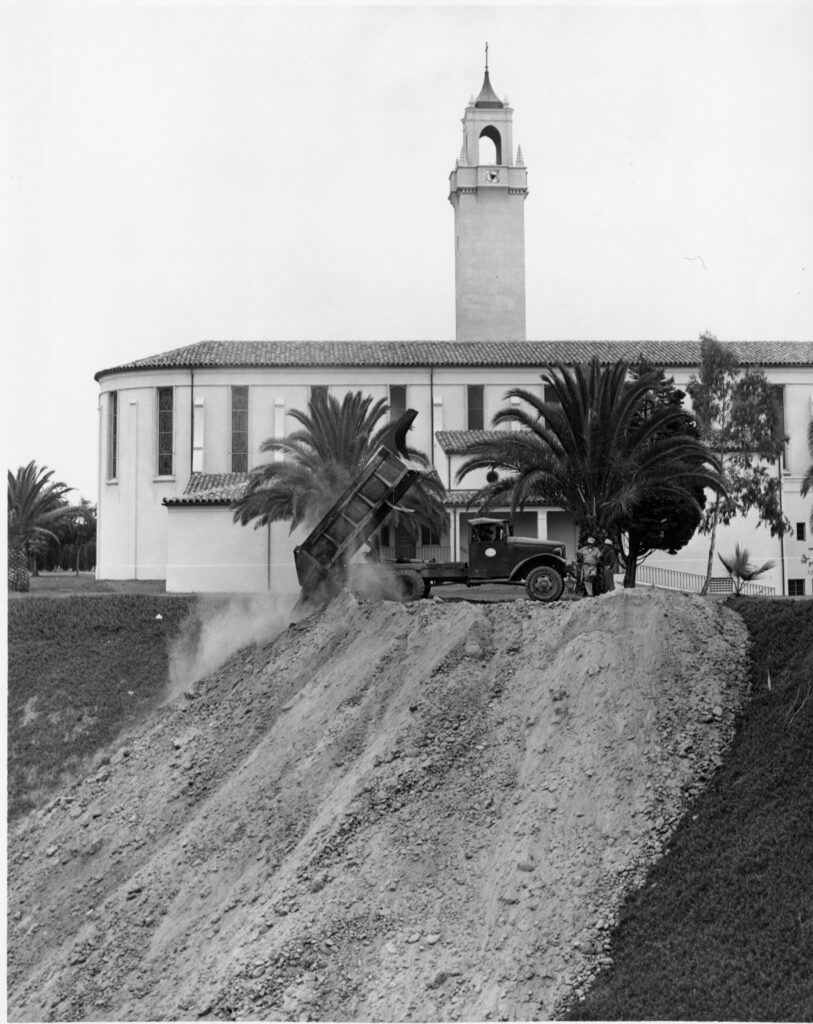
Bluff construction near Church of the Sacred Heart, 1961. (Department of Archives and Special Collections, William H. Hannon Library, Loyola Marymount University)
We are expecting a massive El Niño this winter, one that could bring historic rains to Southern California and the LMU campus. The reality of climate change also means no one can predict future weather patterns anywhere in the Southland, so it may indeed prove true that ours is a house built on sand — and the letters will always be subject to the vagaries of Mother Nature. Who knows? In the meantime, I look forward to the day when I can take the Jefferson exit off the 405 — or better, drag-race my way down the 90 to the beach — and see those three iconic letters off to the left. In the meantime, the residents of Los Angeles might keep in mind that the original “L” predates both UCLA’s famous Royce Hall and USC’s Tommy Trojan by a year or two. As befits the oldest institution of higher learning in Southern California.
James T. Keane ’96, a frequent contributor to LMU Magazine, is the literary editor of America magazine and the author of “Reading Culture Through Catholic Eyes: 50 Writers, Thinkers & Firebrands Who Challenge & Change Us.” His essay titled “The Ghost Town at Runway’s End” appeared in the summer 2026 issue of LMU Magazine.
Photo, top: Freshman students painting the “L” logo of Loyola University on the bluff, 1960. (Department of Archives and Special Collections, William H. Hannon Library, Loyola Marymount University)